
Idaho County Arrest Records and Charges
Arrest records and court charge records answer different questions. An arrest record is tied to law enforcement custody, booking, reports, and the first claim that a person was taken into custody or cited. A court charge record starts when a criminal allegation is filed in the District Court or Magistrate Division. In Idaho County, the sheriff, local police, and other law enforcement channels may create reports, but the Prosecuting Attorney decides whether criminal charges are filed on behalf of the People of Idaho.
The Idaho County inmate list can show public custody clues such as a name, photo, charge or custody status, and bond. It is not a full searchable arrest database. For jail custody and booking detail, the Idaho County inmate records page is the better route. For charges after arrest, iCourt and the Clerk of the District Court / Clerk-Auditor are the court-record channels because they track the filed case and charge status.
The Idaho County Sheriff's Records Division page explains that sheriff reports can lead to prosecution, but reports are not released without a written request.
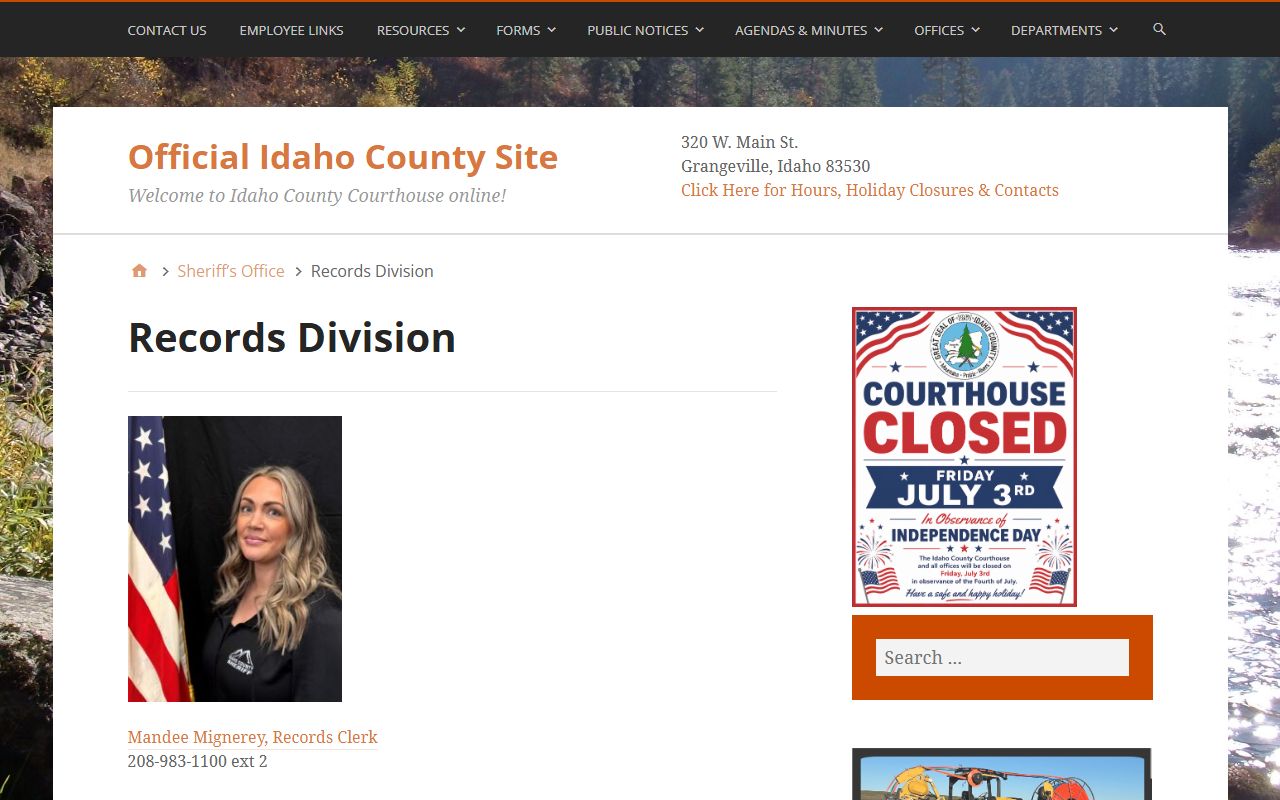
The sheriff records source also notes that some information cannot be accessed while cases are pending adjudication through the courts.
Who Files Idaho County Charges
Idaho County uses a county prosecutor, not a district attorney by that title. The Prosecuting Attorney is Kirk A. MacGregor. The office address is 416 West Main Street, P.O. Box 463, Grangeville, Idaho 83530, with phone (208) 983-0166. The research states that the prosecutor handles felony criminal actions, qualifying misdemeanor and infraction actions, preliminary criminal examinations before magistrates, and civil or criminal matters involving the People, State, or County.
The prosecutor FAQ is direct about the difference between a report and a charge. Crimes generally must be reported to the law enforcement agency with jurisdiction. If the crime occurred in Grangeville, the FAQ points to the local police department. If it occurred in unincorporated Idaho County, it points to the Sheriff's Office. Victims cannot simply drop charges because the prosecutor files criminal charges for the People of Idaho, although victim wishes may be considered.
The Idaho County Prosecutor FAQ is the local source for reporting and charging decisions.
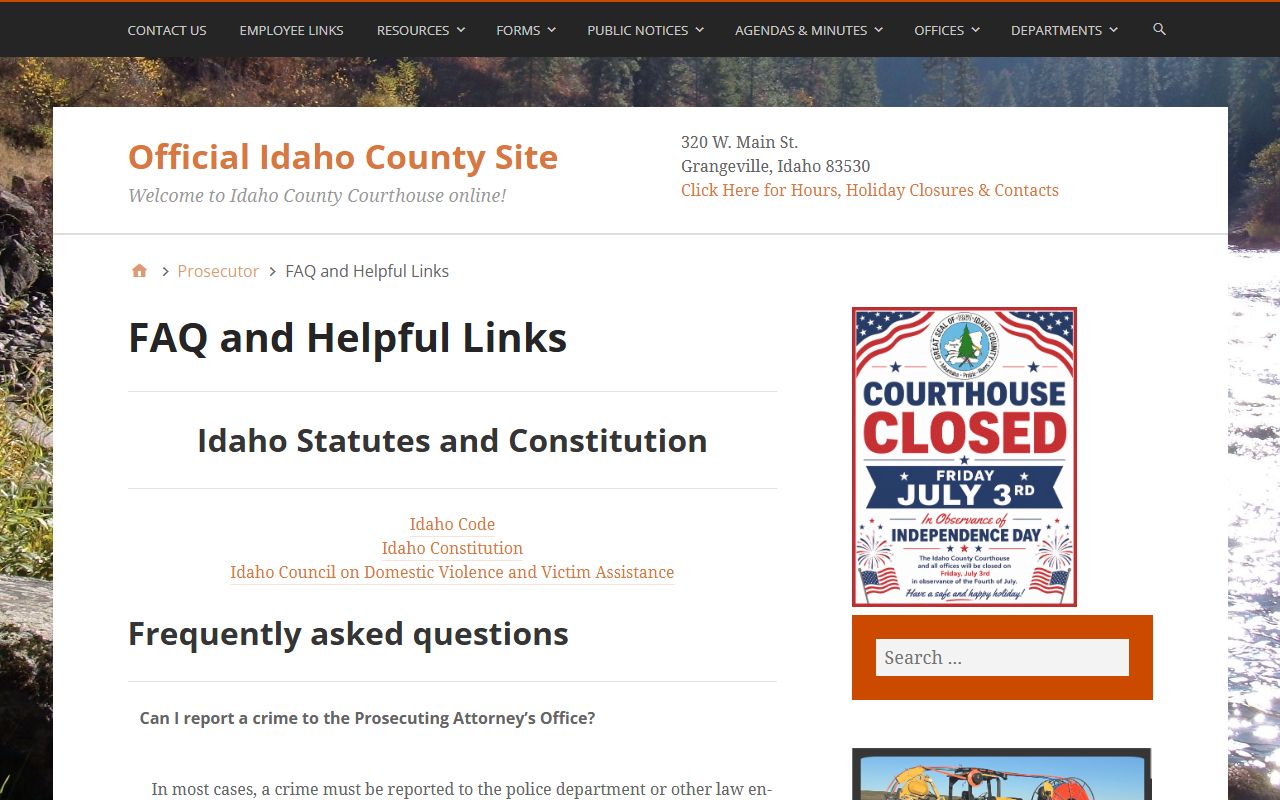
This source supports the core charge-record point: a court charge is controlled by prosecutorial filing, not just by the arrest event.
Arrest Record vs Court Charge
An Idaho County arrest record can exist before a court case is fully resolved. It may be based on a warrant, a citation, a booking entry, a sheriff report, or another law enforcement record. A court charge record is narrower and more formal. It shows the charge filed into court, the status of the charge, and the proceedings that follow. The same arrest may result in no filed charge, one charge, or several charges.
| Record Type | Where It Starts | What It Helps Verify |
|---|---|---|
| Arrest record | Law enforcement, sheriff records, jail custody, or booking process. | Custody event, agency report path, current inmate clues, bond, or warrant status where public. |
| Court charge record | Filed complaint, information, indictment, or citation in court. | Formal allegations, charge level, hearings, amendments, dismissal, and court status. |
| Full criminal case file | District Court or Magistrate Division case record. | Pleas, motions, disposition, sentencing, probation, payment status, and post-judgment events. |
The full case outcome belongs in the Idaho County criminal court records file. A charge page should not be read as proof of guilt unless the final disposition supports that conclusion.
Idaho County Charging Documents
Charges after arrest are filed through documents that start or shape the criminal case. Research for Idaho County identifies common record terms such as complaint, information, indictment, and citation. A complaint can start a misdemeanor or criminal allegation. An information is a prosecutor-filed felony charging document. An indictment is a grand-jury charging document. A citation is often used for traffic or infraction matters.
| Document | Filed By | Common Use | Why It Matters |
|---|---|---|---|
| Complaint | Law enforcement or prosecutor, depending on case path. | Initial criminal charging document. | Shows the first formal count or allegation filed in court. |
| Information | Prosecutor. | Many felony cases after review or preliminary process. | Can define the felony charges that proceed in District Court. |
| Indictment | Grand jury. | Serious or grand-jury-filed criminal matters. | Shows charges returned through grand-jury process. |
| Citation | Officer or agency. | Traffic, infraction, or lower-level charging notice. | Can create a court case, payment record, or hearing setting. |
One arrest may have several filed counts. Each count may have its own status, and the status may change as the prosecutor amends the filing, as the court rules on motions, or as the parties reach a plea agreement.
Search Idaho County Charges After Arrest
For court charges after arrest, start with iCourt Smart Search. Search by case number when it is known. If it is not known, search by name in last-name, first-name format and filter by Idaho County. Advanced filters can narrow by case type, case status, file date, and judicial officer. The public portal may show the charge list, hearings, case status, and chronological entries when not sealed or confidential.
- Search iCourt by defendant name, case number, or record number.
- Filter by Idaho County when statewide results include other counties.
- Open the case status and read the charge list before reading docket events.
- Check each count for current status, amendment, dismissal, plea, or disposition.
- Use the Clerk of the District Court / Clerk-Auditor or courthouse kiosk for court-file copies.
For arrest-side records, the sheriff Records Division says written requests are required. For current jail custody clues, the inmate list can show a public charge or status line and bond, but it does not show booking number, date of birth, booking time, arresting agency, court case number, court date, holding location, or release date in the captured public text.
Idaho County Charge Status Terms
Charge status is the part of the record that prevents a charge list from being mistaken for a final result. A charge may remain pending, be amended, be reduced to a different severity level, be dismissed, or end in a conviction after plea or trial. Idaho County records may show these changes in the docket summary or in the filed documents requested from the clerk.
| Status | What It Means | Record Reading Tip |
|---|---|---|
| Pending | The charge is filed and has not reached a final public disposition. | Check the next hearing and recent docket events. |
| Amended | The filed charge or charging document changed after filing. | Read the later entry, not just the first charge description. |
| Reduced | The charge moved to a less serious count or classification. | Compare the original and final charge status. |
| Dismissed | The charge was ended without conviction on that count. | Do not treat the dismissed count as a conviction. |
| Acquitted | The person was found not guilty on that count. | Use the verdict or disposition entry to verify. |
| Convicted | The charge resulted in a guilty plea, verdict, or qualifying final finding. | Read sentencing terms and later relief entries. |
Idaho County's Prosecutor page references Drug Court as part of the local criminal justice setting. That does not mean every drug case is diverted. It means some qualifying cases may have court-supervised treatment or program events that should be read in the actual case record.
Idaho County Charge vs Conviction
A charge is not the same as a conviction. This distinction matters for Idaho County arrest records because an arrest may be followed by filed charges, but those charges can change or fail before final judgment. The most reliable reading is to pair the charge entry with the final disposition and sentencing entry.
| Question | Charge | Conviction |
|---|---|---|
| What is it? | A formal allegation filed into court. | A final outcome after plea, verdict, or qualifying disposition. |
| When does it appear? | Early in the case, often before arraignment or preliminary proceedings. | After the court resolves the count. |
| Can it change? | Yes. It may be amended, reduced, added, or dismissed. | Later relief may affect how it appears, but the conviction must be read from the final record. |
| Where is it checked? | iCourt charge list, charging document, and court docket. | Disposition, judgment, sentencing entry, or clerk-certified record. |
Victims may call the Prosecutor's Office for next court date information if charges have been filed, according to the prosecutor FAQ. For the public, iCourt hearing search is the main statewide calendar path when the hearing is public.
State Criminal History Records
Court charge records and state criminal history records are also different. Idaho State Police Bureau of Criminal Identification handles criminal history records and certain expungement processes. A statewide criminal history may draw from arrest and court data, but the Idaho County court case remains the source for local docket events, charge status, disposition, and sentencing.
The Idaho State Police criminal history page explains statewide criminal-history context.
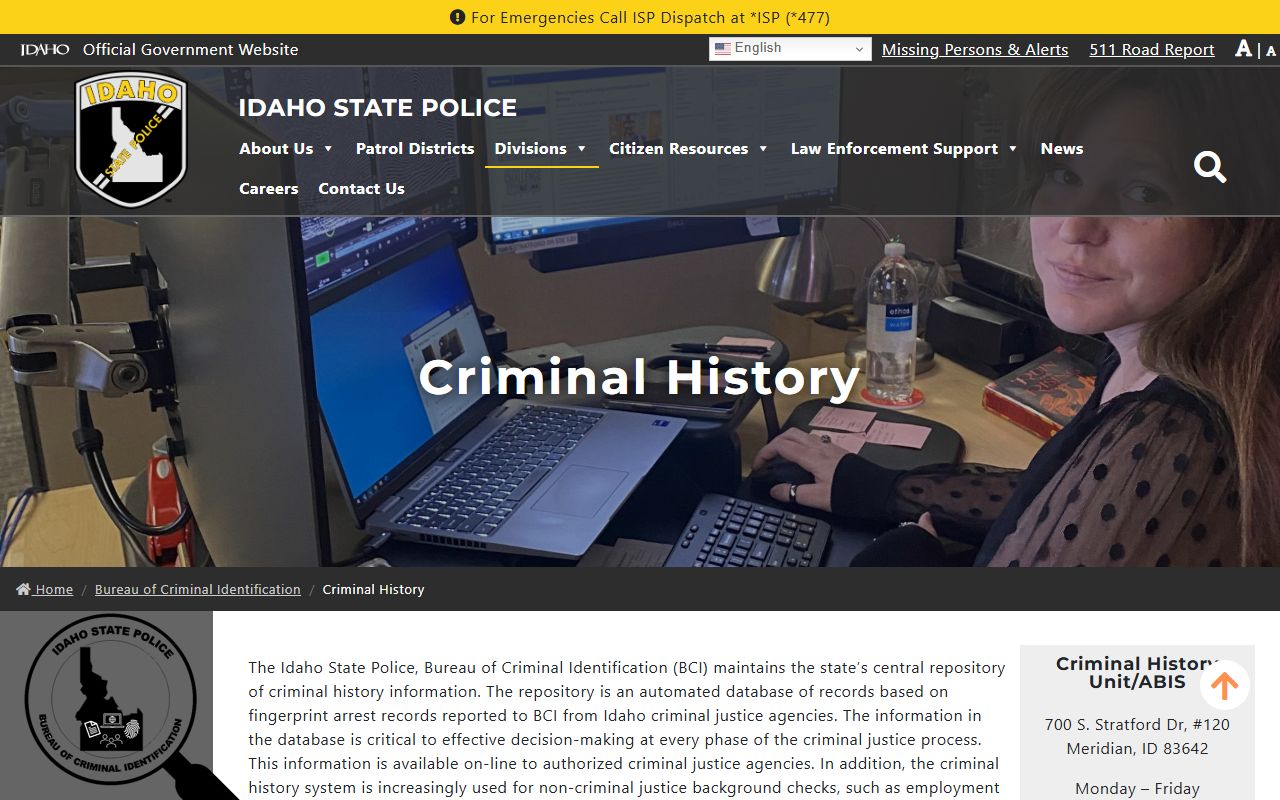
State criminal history access is useful for background context, but it does not replace the county case file or clerk-certified court documents.
Restricted Idaho County Charge Records
Public access to arrest records and court charges has limits. Idaho Court Administrative Rule 32 controls court record access. Idaho Code section 74-105 exempts some law enforcement and investigatory records, especially where release could interfere with enforcement or adjudication. Sheriff Records Division research says some information cannot be accessed while cases are pending adjudication through the courts.
Idaho Code section 74-105 is one authority for law enforcement and investigatory limits.
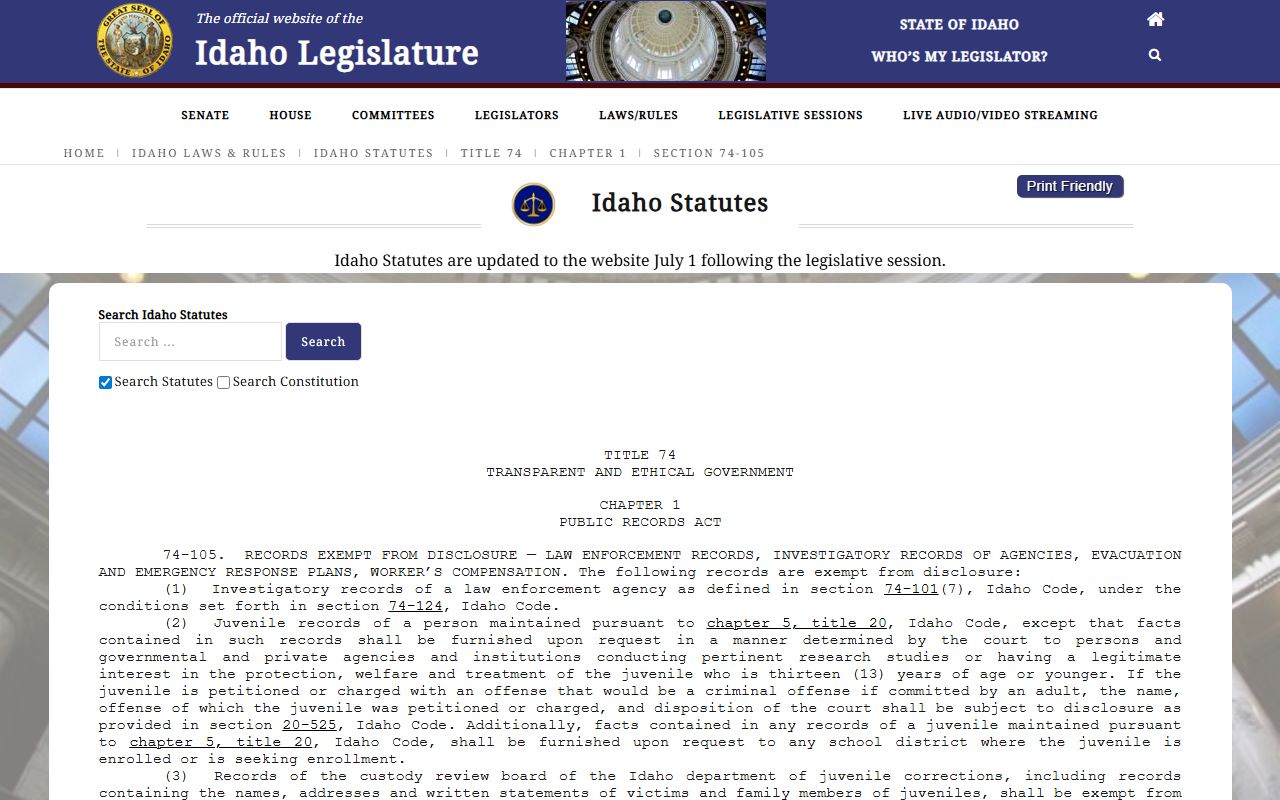
This statute is one reason a sheriff report may be unavailable even when a public court case exists.
Access point: Use iCourt for public court charge status, written sheriff requests for agency reports, and clerk requests for filed court records.
Idaho County Sealed vs Expunged Charges
Sealed and expunged charge records should not be treated as the same thing. A sealed charge or case is hidden from ordinary public access by rule, statute, or court order. An expungement or discharge route is limited and depends on the record type. Idaho research identified Idaho Code section 67-3004(10) for qualifying nonconviction criminal history records through Idaho State Police, and Idaho Code section 19-2604 for certain court relief after probation.
| Point | Sealed | Expunged or Dismissed |
|---|---|---|
| Portal effect | May not appear on public iCourt. | May affect criminal history or final disposition depending on the route. |
| Common basis | ICAR 32, juvenile confidentiality, court order, or statutory restriction. | Nonconviction expungement, discharge, dismissal, or felony reduction where eligible. |
| Proof needed | Court order or authority controlling access. | Arresting agency records, court records, and certified dismissal or acquittal documents may be needed. |
| Caution | No public search hit does not prove no record exists. | Relief is narrow and should be verified with official court or ISP records. |
Idaho Code section 67-3004 is the cited authority for qualifying nonconviction criminal history expungement.
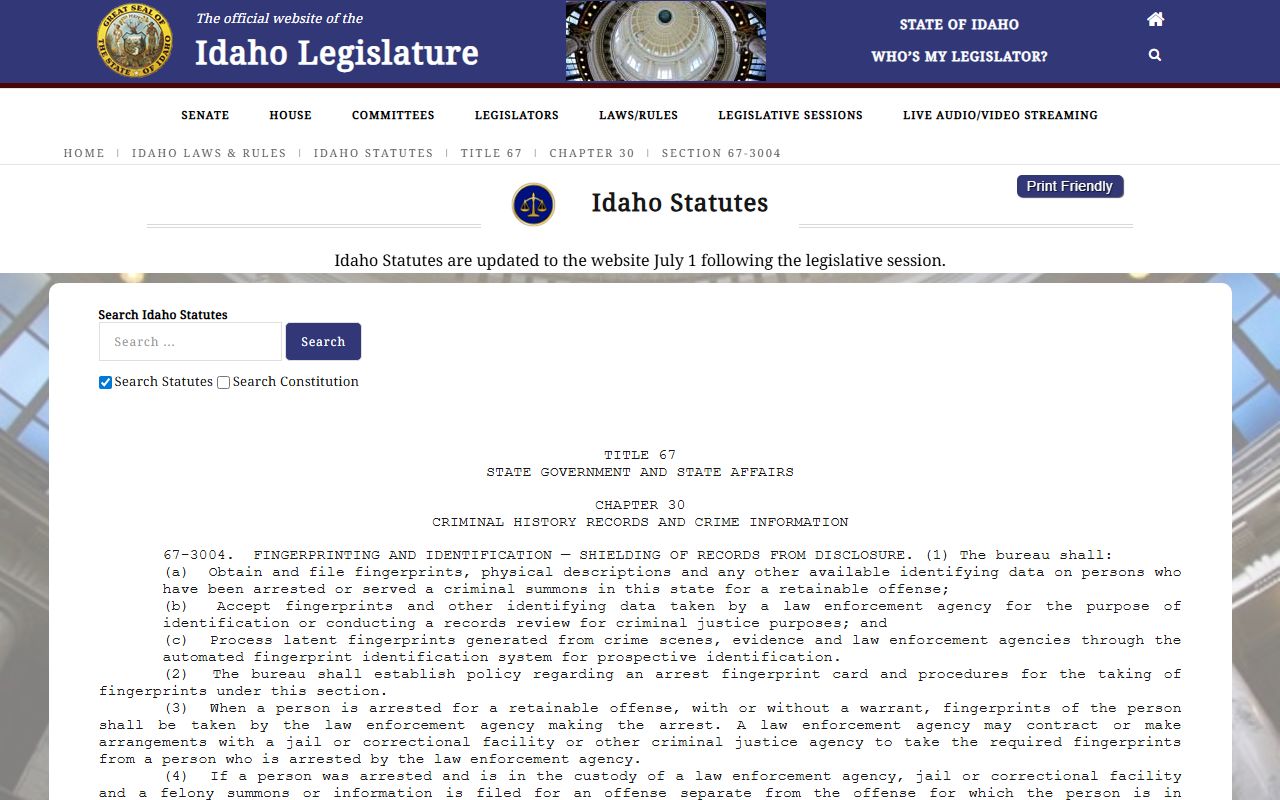
The statute supports a narrow nonconviction route and should not be read as a general erase-all rule for Idaho County charges.
Idaho County Charge Relief Records
Idaho State Police expungement materials ask for charge, acquittal, dismissal, and supporting record information. The listed supporting documents can include a criminal citation, complaint or summons, indictment, information, and certified court order of acquittal or dismissal depending on the basis. That is why an Idaho County charge-record search often must reach both the court file and statewide criminal history channels.
The research also identified the Idaho State Police expungement application PDF, which asks for charge and court-document details when a person seeks qualifying relief.
Note: For legal use, request certified court records from the Clerk of the District Court / Clerk-Auditor rather than relying only on a public portal view.
Important: Public arrest or charge lookups are not FCRA consumer reports and should not be used for regulated screening decisions.